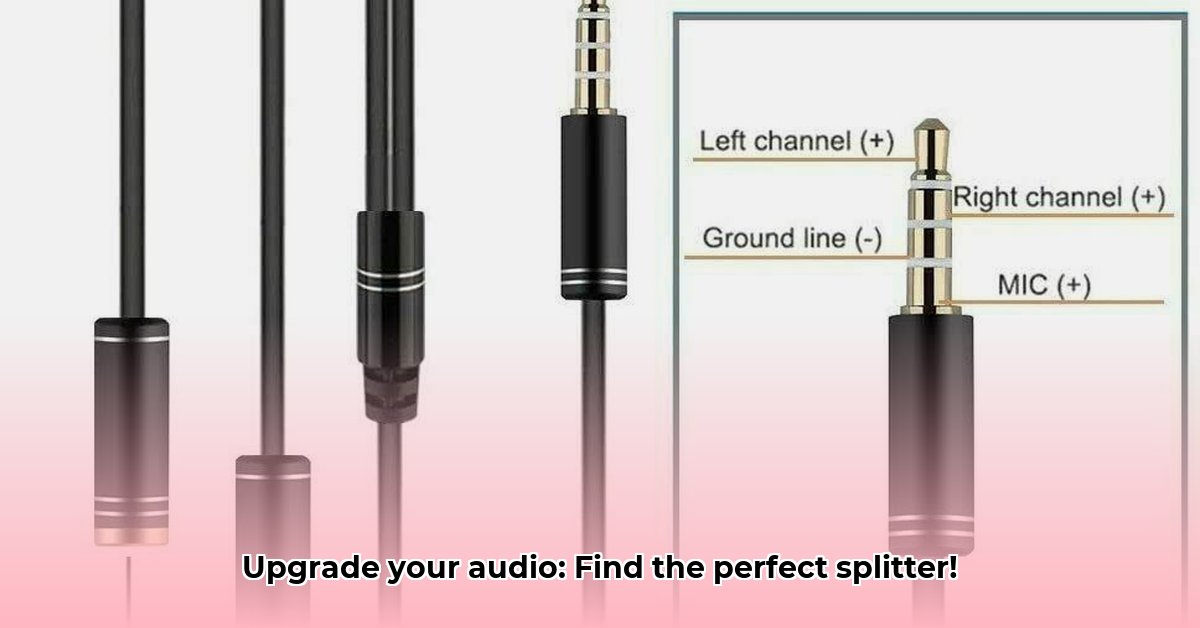
Audio Splitter Y: Your Guide to Better Sound
Want to enjoy your favorite music on multiple headphones or power several speakers from a single device? An audio Y-splitter is the solution! This guide clarifies the choices, making it easy to select the perfect splitter for your setup. Did you know that using the wrong Y-splitter can actually damage your equipment? Let's explore how to avoid that.
Decoding the World of Audio Y-Splitters: Passive vs. Active
An audio Y-splitter duplicates an audio signal, sending it to two or more destinations. The key difference lies between passive and active splitters.
Passive Splitters: The Simple Approach
Passive splitters operate like a simple tee in a water pipe, directly splitting the audio signal. They're inexpensive and easy to connect. However, since they don't amplify the signal, you may notice a volume drop, especially with multiple outputs or long cables. This is similar to how water pressure decreases in a hose with multiple branches. Passive splitters are ideal for short, simple setups where high-volume isn't critical. Is a slight volume reduction acceptable for your needs?
Active Splitters: Powering Up Your Sound
Active splitters are like adding a pump to a water system; they amplify the signal to maintain its strength. This ensures consistent, clear sound even with multiple devices or long cables. While more expensive, the superior sound quality and reliability are often worth the investment, especially for serious audio enthusiasts or complex setups. For professional applications, active splitters are virtually essential.
Beyond passive or active, consider the connector type. You'll find 3.5mm jacks (common for headphones and portable devices), RCA connectors (typically for home stereo systems), and XLR connectors (used in professional audio). Ensure your splitter's connectors match your devices.
Choosing the Right Audio Y-Splitter: Key Considerations
Selecting the best Y-splitter depends on several factors:
Output Quantity: How many outputs do you need? Two headphones? Four speakers? This determines the required number of outputs.
Connector Matching: Verify that the splitter's connectors (3.5mm, RCA, XLR, etc.) are compatible with your audio source and destination devices.
Passive vs. Active: Active splitters provide superior sound quality, particularly with multiple outputs or long cables, but cost more. Passive splitters are budget-friendly but may result in a weaker signal. Consider your setup and budget when making this choice.
Impedance (Resistance to electrical current): Matching the impedance of your splitter with your audio devices is crucial for optimal audio quality. Mismatched impedance can weaken the signal or damage equipment. This is more critical for passive splitters. Active splitters are less sensitive.
Signal Quality: Check online reviews for insights into noise levels and sound quality.
Connecting Your Audio Y-Splitter: A Step-by-Step Guide
Connecting an audio Y-splitter is usually straightforward:
Identify the Audio Source: Locate your device's audio output (computer, phone, etc.).
Identify Destinations: Determine where the audio should go (headphones, speakers, etc.).
Connect the Source: Plug one end of the Y-splitter into your audio source’s output jack.
Connect the Destinations: Plug the other ends into your output devices.
Test and Enjoy: Play audio to ensure everything works. If not, double-check all connections.
Consult your device manuals for specific connection instructions.
Expanding Your Sound Horizons: Applications Beyond Headphones
Audio Y-splitters offer many applications:
Home Theater Enhancement: Connect multiple speakers or subwoofers to your A/V receiver for richer sound.
Multi-Room Audio: Enjoy the same music throughout your home.
Professional Audio: Y-splitters distribute audio signals to multiple recording devices or amplifiers.
Troubleshooting: When Things Go Wrong
If you have issues, try these steps:
Check Connections: Ensure all connections are secure.
Test with Different Cables: A faulty cable might be the issue.
Impedance Check: Confirm impedance matching, especially for passive splitters.
Power Check (if applicable): For active splitters, ensure proper power supply.
Audio Y-Splitter Comparison: A Quick Glance
| Feature | Passive Splitter | Active Splitter |
|---|---|---|
| Cost | Lower | Higher |
| Signal Boost | No | Yes |
| Impedance Matching | Critical | Less critical |
| Ideal for | Short cable runs, few outputs | Long cable runs, multiple outputs |
Choosing the right audio Y-splitter significantly improves your audio setup. By understanding the different types and following these tips, you can select the ideal splitter to enhance your listening experience.
⭐⭐⭐⭐☆ (4.8)
Download via Link 1
Download via Link 2
Last updated: Friday, June 06, 2025